Auszeichnung
künstlerischer Projekträume
und -initiativen
Auszeichnung
künstlerischer Projekträume
und -initiativen
Archiv
:
2023
,
2022
,
2021
,
2020
,
2019
,
2018
,
2017
,
2016
,
2015
,
2014
,
2013
,
2012
Events
Archiv
Information
Stipendien 2021
Stipendien 2022
Statements
Rückblick
Kontakt
Impressum
2020
,
The Watch
2020
,
2016
Puschkinallee
55
Berlin
12435
thewatch-berlin.org
Transmissions,
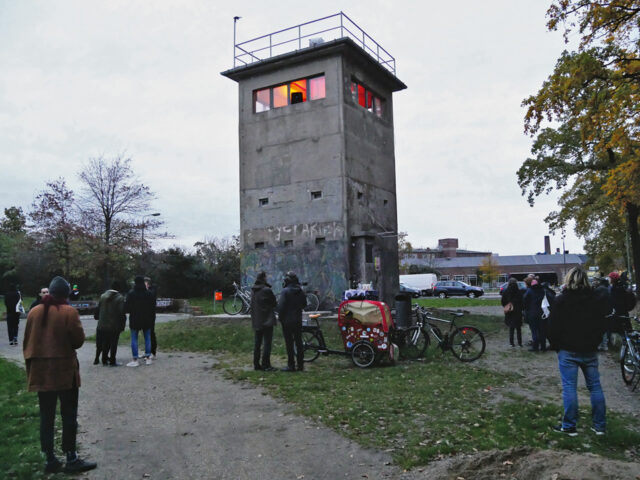
2019, Foto: Jo Zahn
Ciarán Walsh, 2021, Foto: Ciarán Walsh
To run a space is a form of appreciation of other artists, it is an outcome of friendship and mutual understanding; it is an indication of trust between all involved. To run a space means to take responsibility. To run a space is not only self-organization – money may not be vital to put up a show – but it is for sure necessary to animate a space and keep it alive. The prize comes due to hard and merited work, but maybe a grant would be more befitting than a prize? Maybe an iron scaffold holding up a structure in advance is better suited than a gold star for accomplishments? To run a space is a full time job. A group of artists who share their enthusiasm, interests, time, and skills would impart a project with a larger circulation of assignments between the makers. I am convinced that the longevity and success of a space relies on a horizontally organized (net) work.
The city has become more expensive overall and therefore there is less free space – there are less “Freiräume”. Our definition has not changed as a project space. The concept of an ideal space is completely dependent on what the organizers/artists/curators are interested in doing. In our opinion, there isn’t ONE type of space that is ideal which is actually what is so wonderful about project spaces in general – they are diverse, and completely different. It seems that because of the lack of spaces and the increased rents, more project spaces have turned towards commercial models. But since funding has become more commonplace in the scene, meaning it’s more common to pay artists who are involved in shows, performances, readings, events, etc. at project spaces, this has put more pressure on spaces in general to have to secure financing. We would argue that since funding has become more readily available, the structures have begun to change. It’s a bit of a double-edged sword. It’s wonderful to receive funding and be able to support artists, and as a result, the scene has become much more professional. But at the same time, it is harder in some ways to do projects more spontaneously and in an improvised fashion. This, as a result, has changed the (power) dynamics between the artists and the project space organizers, as very often the organizers are NOT funded but the artists participating in the projects are. This creates a rather awkward dynamic and as organizers ourselves, it’s frustrating for us to not be paid for our efforts and contributions to the “Freie Szene”.
„Und so lange die Länge reicht Die werke der_die dichter und Innen die bildner und Innen und innen darstellen die künste multimed und überhaupt enthalten unerkanntermaßen einen Schatz tiefer Weisheit: eben weil. Aus ihnen die weisheit der natur der dinge selbst redet deren aus sie sagen sie bloß durch verdeut und lichtung und reinere wieder und holung verdolmetschen. Deshalb muss aber frei ich und du auch jeder_jede der_die das gedicht liest das kunstwerk betrachtet aus eigenen mitteln beitragen jene weisheit zu tage zu fördern. Folglich fasst er_sie nur so viel als seinen_deine fähigkeit und seine_unsere_ihre bildung es zulässt wie ins tiefe meer jeder schiffer sein jede schifferin ihre senkblume so tief hinab lässt als dessen_deren länge reicht.“ Gedicht: Elisa Asenbaum, frei nach Arthur Schopenhauer Kunst ist integrativ, kann aber genauso schnell vereinnahmt werden. Daher ist es notwendig, durch unabhängige Projekträume Strukturen zu schaffen, die die Autonomie der Kunst erhalten und stärken und die Produktion von Kunst jenseits von ökonomischen oder gesellschaftlichen Zwängen und Gegebenheiten ermöglichen. Nur so kann Kunst ihre gesellschaftliche Aufgabe erfüllen, die idealerweise unbestimmt und wandelbar ist.