Auszeichnung
künstlerischer Projekträume
und -initiativen
Auszeichnung
künstlerischer Projekträume
und -initiativen
Archiv
:
2023
,
2022
,
2021
,
2020
,
2019
,
2018
,
2017
,
2016
,
2015
,
2014
,
2013
,
2012
Events
Archiv
Information
Stipendien 2021
Stipendien 2022
Statements
Rückblick
Kontakt
Impressum
2017
,
bi’bak
2020
,
2017
,
2014
Prinzenallee
59
Berlin
13359
bi-bak.de
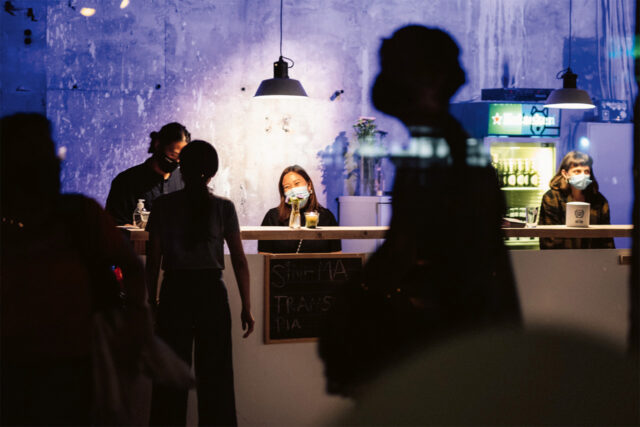
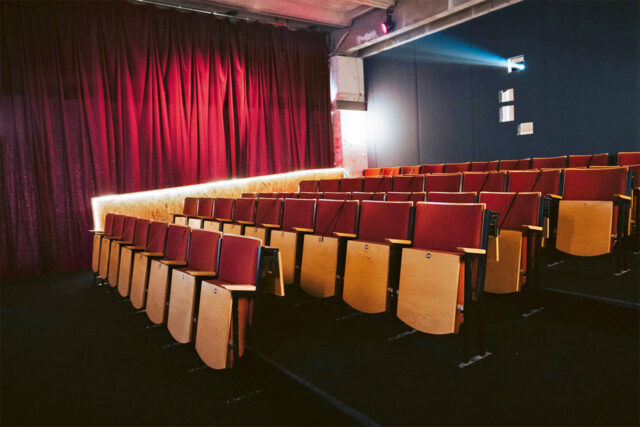
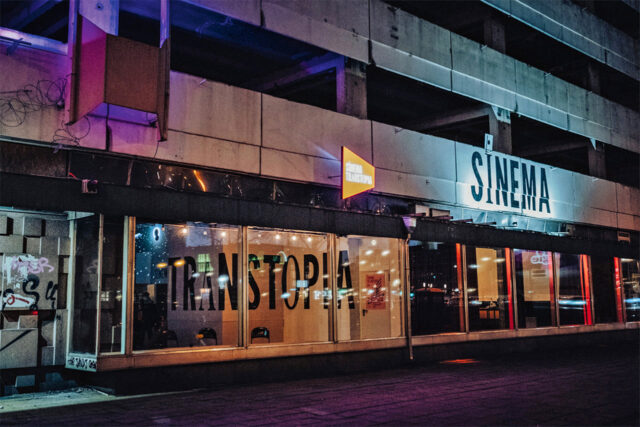
Sinema Transtopia, Haus der Statistik
Sinema Transtopia, Haus der Statistik, 2021
The city has become more expensive overall and therefore there is less free space – there are less “Freiräume”. Our definition has not changed as a project space. The concept of an ideal space is completely dependent on what the organizers/artists/curators are interested in doing. In our opinion, there isn’t ONE type of space that is ideal which is actually what is so wonderful about project spaces in general – they are diverse, and completely different. It seems that because of the lack of spaces and the increased rents, more project spaces have turned towards commercial models. But since funding has become more commonplace in the scene, meaning it’s more common to pay artists who are involved in shows, performances, readings, events, etc. at project spaces, this has put more pressure on spaces in general to have to secure financing. We would argue that since funding has become more readily available, the structures have begun to change. It’s a bit of a double-edged sword. It’s wonderful to receive funding and be able to support artists, and as a result, the scene has become much more professional. But at the same time, it is harder in some ways to do projects more spontaneously and in an improvised fashion. This, as a result, has changed the (power) dynamics between the artists and the project space organizers, as very often the organizers are NOT funded but the artists participating in the projects are. This creates a rather awkward dynamic and as organizers ourselves, it’s frustrating for us to not be paid for our efforts and contributions to the “Freie Szene”.
There is probably no ideal project space, and that is exactly what is ideal about this format; the openness and the freedom that allows it to take any shape and direction. Project spaces are versatile structures that can be morphed in many different ways, reflecting the circumstances and the people that are part of the process. To us, a project space is a kind of utopia, although there is no fixed concept of an ideal project space. Project spaces are very much constantly evolving, changing, and adapting.
Die unweigerlich fortschreitende Gentrifizierung schränkt die künstlerischen Freiräume weiter ein. Dank des Engagements des Netzwerks freier Berliner Projekträume und -initiativen wurde die Szene jedoch zum Politikum, erreichte eine breitere Öffentlichkeit und erfuhr zudem durch neu eingerichtete Fördermöglichkeiten eine wirtschaftliche Stärkung. Die Vernetzung führte neben dem inhaltlichen Austausch zu verschiedensten Kooperationen und insbesondere zu einem solidarischen Kollektivbewusstsein. Insofern ist die Szene ähnlich vital wie in den 1990er-Jahren, zwar nicht mehr so spontan und verrückt, aber dafür um einiges professioneller. Das Selbstverständnis der freien Projekträume wandelte sich tendenziell von der Eventkultur des Nachwendeberlins zu einem diskursorientierten Ansatz in institutionsähnlichen Strukturen. Abgesehen davon, dass die meisten Projektraumbetreiber*innen selbst Künstler*innen sind, wurde die Zusammenarbeit von Organisator*innen und rein kreativ Schaffenden verbindlicher und seriöser. Wichtig ist hierbei auch die obligatorische Auszahlung von Ausstellungshonoraren als wirtschaftliche Anerkennung für künstlerische Leistungen. Die Veränderung der Strukturen erfolgte fließend.