Auszeichnung
künstlerischer Projekträume
und -initiativen
Auszeichnung
künstlerischer Projekträume
und -initiativen
Archiv
:
2023
,
2022
,
2021
,
2020
,
2019
,
2018
,
2017
,
2016
,
2015
,
2014
,
2013
,
2012
Events
Archiv
Information
Stipendien 2021
Stipendien 2022
Statements
Rückblick
Kontakt
Impressum
2017
,
SCOTTY e. V.
2017
,
2006
Oranienstraße
46
Berlin
10969
scotty-berlin.de
GLUE,
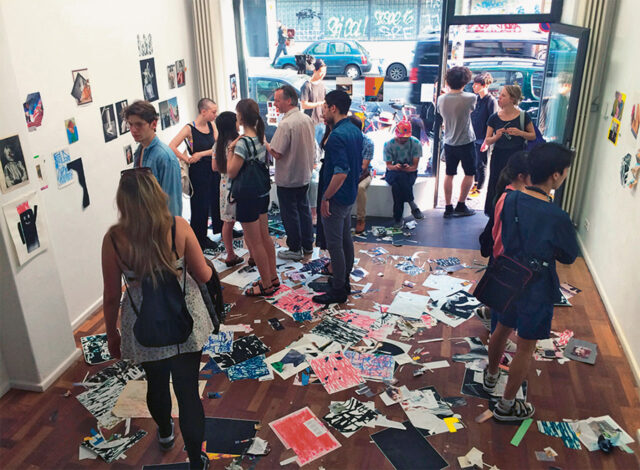
Gruppenausstellung, kuratiert von Anelor Robin, 2016, Foto: Julia Krewani
Answering this question seems to be the most difficult and an endless process for me because I have to ruminate on the past decade or so in which I have gone through Berlin as a female artist, a Korean artist, the founder and chief of an Asian contemporary art platform, and a mother. Since the very beginning, I have been interested in seeking a kind of universal identity, spanning the various backgrounds of Berlin-based contemporary artists in order to examine the question of identity as it is often perceived from the outside: according to gender, nationality, and cultural milieu. So I have created a space where the dichotomous logics about those issues could be discussed, proceeding with many projects. Above all, I had dreamt of creating a self-supporting space, based on an independent profit model. Recognizing limitations in workforce, culture, and the market of the art scene, however, I have experienced some moments of great suffering. But what has enabled me to endure those moments of suffering was not money but people, so that I would answer sincerely that a project space no longer means a physical space for me. It is a non-physical space, comprising people like artists, users and agents, or sometimes a network.
Es ist wichtig, die Räume als freie, unabhängige Räume zu sichern und dies nicht unmittelbar an eine spezifische, lückenlose Konzeption oder einen wie auch immer definierten Erfolg zu knüpfen. Aufgeschlossen gegenüber wirklich offenen künstlerischen Prozessen und aufgeschlossen im Sinne einer nicht normativen Plattform für künstlerische Experimente können die Räume nur sein, wenn es Förder- und Sicherungskriterien gibt, die nicht einer bloßen Markt- und Verwertungslogik folgen. Austausch, Resonanz und Verknüpfung sind wichtige Momente – wie kann ein wirklich solidarisches Miteinander der Projekträume aussehen, bei dem es nicht um Konkurrenz und Profilierung gegeneinander geht?
Berlin ist zwar noch interessant, jedoch gibt es inzwischen auch andere europäische (vor allem osteuropäische) Metropolen, die mit ähnlichen Attributen wie Berlin werben.