Auszeichnung
künstlerischer Projekträume
und -initiativen

Neue Berliner Räume e. V.

2011
Initiative

Jodie Carey, A Room That Was Never Meant To Be, 2013, Foto: Benjamin Busch
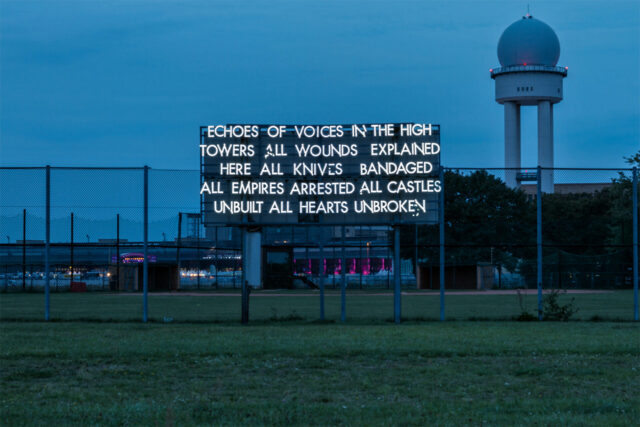
Robert Montgomery, Echoes of Voices in the High Towers, 2018, Foto: Benjamin Busch

In the early years, we were not thinking so much about accessibility to our exhibitions and events in a physical sense of venues without elevators or events without translation, but also in a digital sense. For many years, our online magazine hadn’t been accessible for screen-readers for people with poor vision or the blind, or keyboard navigation for people with mobility issues, for example. Getting there was a journey, and I think we would now start from a more accessible place. I would want local politicians to make their funding applications more accessible, not only in terms of able-ism, but also in terms of all forms of discrimination, e.g. proof of citizenship, applications having to be written in German. I wish that they would give a universal basic income to everyone (not just citizens), open their borders, and make healthcare free, free for everyone.Mangelnde Vernetzung führt zu unnötigen Konkurrenzsituationen im Kampf um Aufmerksamkeit und Fördertöpfe. Der ideale Projektraum ist/war eine Win-win-Situation für Betreiber*innen und Künstler*innen. Beide können neue Experimente starten und neue Modelle ausprobieren unter fairen finanziellen Bedingungen, sprich mit Honorar und Projektfinanzierung/Sponsoren. Projekträume haben sich auch durch Verdrängung und höhere Mieten in entlegene Kieze und Bezirke verlagert/verlagern müssen. Wir alle sind Teil eines „idealen“ Projektraums, zusammen sind wir höchst heterogen, divers und das größte zusammenhängende Ausstellungshaus in Berlin. In Berlin hat sich in den letzten zehn Jahren das Verhältnis zu Raum als einer grundlegenden Basis für unser Zusammen­leben dramatisch verändert − und zwar aus der Perspektive der künst­lerischen Nutzung eindeutig zum Schlechten. Der Profitwahnsinn hat die Stadt seit der Finanzkrise zunehmend erfasst; sowohl ­global agierende Finanz- und Immobilienhaie als auch viele mittlere und kleine Geldanleger haben Berlin und seine umbauten Räume als handelbare Ware auserkoren mit der Folge, dass die Preise dafür explodiert sind. Die Politik unternimmt dagegen ­leider nichts wirklich Effektives und scheint daran kaum Anstoß zu ­nehmen. Darunter leiden in erster Linie die sozial Schwächeren und nicht zuletzt die meisten Kunst- und Kulturschaffenden. Berlin ist im Begriff, seine Ausstrahlung und seinen Nimbus als Anziehungspunkt für experimentelle und innovative Kunstprojekte zu verlieren. Wir hoffen, dass sich weiterer Widerstand gegen diese allgemeine Tendenz gerade auch aus dem Feld der Kunst regt und Berlin weiterhin ein Ort für lebendige und kritische Kunst sein wird.To run a space is a form of appreciation of other artists, it is an outcome of friendship and mutual understanding; it is an indication of trust between all involved. To run a space means to take responsibility. To run a space is not only self-organization – money may not be vital to put up a show – but it is for sure necessary to animate a space and keep it alive. The prize comes due to hard and merited work, but maybe a grant would be more befitting than a prize? Maybe an iron scaffold holding up a structure in advance is better suited than a gold star for accomplishments? To run a space is a full time job. A group of artists who share their enthusiasm, interests, time, and skills would impart a project with a larger circulation of assignments between the makers. I am convinced that the longevity and success of a space relies on a horizontally organized (net) work.